Resource page · Florida workflow guide

2026 Business-Day Calendar for Florida Real Estate Deadlines

This page is the operational companion to the federal-holiday list. Instead of just showing the dates, it focuses on how 2026 business-day counting affects real transaction timing in Florida: which weeks become tighter, where deadlines are most likely to slip, and how agents and transaction coordinators can plan around the risk.

Calendar vs. business dayThat distinction is where many deadline errors begin.
4 critical periodsJune/July, Veterans Day week, Thanksgiving week, and year-end deserve extra planning.
Florida workflow focusBuilt for agents, coordinators, assistants, and team admins managing multiple files.
Created planning visual
Example of how business-day counting changes a Florida real estate deadline in 2026
A practical example of how one observed holiday can change the actual date a deadline lands on.
Planning toolThis page is meant to help you structure a 2026 workflow, not just memorize holiday dates.
Florida relevanceThe examples are tailored to how agents and coordinators actually manage contract-to-close work.
Software bridgeThe point is not to count forever by hand. It is to know where the hand-counting risk lives.
Business-day basics

What a business-day calendar means in real estate

A business-day calendar is not just a list of weekdays. It is a planning tool that helps you see which days are likely to count, which days are likely to be excluded, and where a deadline window may tighten because the people who need to act are unavailable.

In real estate, that matters because some deadlines are measured in calendar days and others in business days. The contract language controls the actual legal rule. Operationally, though, Florida professionals still need to know which weeks are likely to compress underwriting, title, inspections, HOA responses, or recording.

FYI
Snippet-friendly definition

A business-day calendar for real estate is a planning view that helps you account for weekends, observed holidays, and operational closures when managing deadline-driven transaction work.
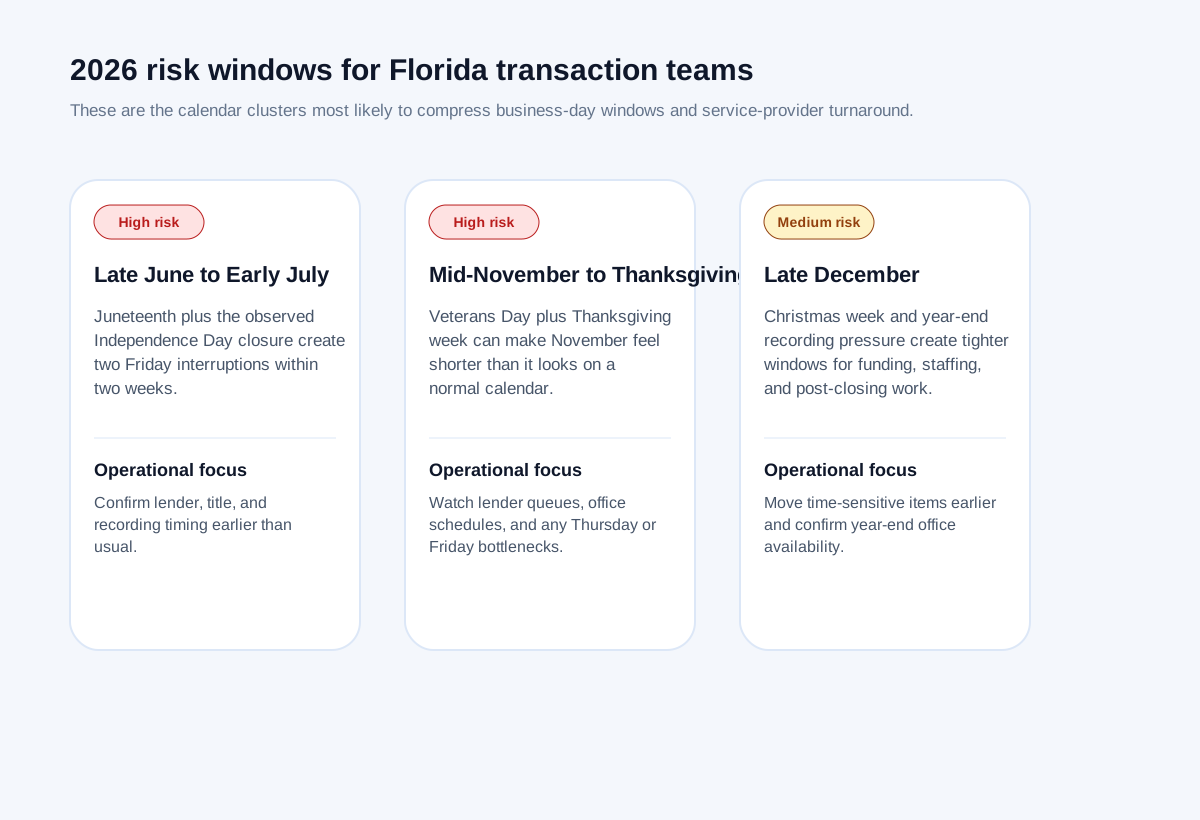
Business-day counting example for a Florida real estate deadline in June 2026
This is the kind of scenario that trips people up: the deadline window looks long enough until one observed holiday removes a working day.
2026 planning map

Month-by-month risk view for Florida transaction teams

This is where Page 2 becomes distinct. Instead of repeating the holiday list, the goal here is to show when the workflow itself becomes more fragile during 2026.

January
Moderate

New Year’s Day and MLK Day create two early-month interruptions. Good time to reset deadline habits after year-end closings.

February
Moderate

Washington’s Birthday affects lender and title timing. Less disruptive than summer or Thanksgiving, but still worth flagging.

May
Moderate

Memorial Day turns one spring week shorter than it looks, especially for title and inspection scheduling.

June
High

Juneteenth on Friday, June 19 reduces the available business days in a month when many active transactions are already moving fast.

July
High

The observed Independence Day closure on Friday, July 3 is the one most likely to be counted incorrectly.

September
Moderate

Labor Day is predictable, but it still compresses early-September files and can push response windows later in the week.

October
Lower

Columbus Day can affect banks even when some local offices are open. Check the actual players involved in the deal.

November
High

Veterans Day plus Thanksgiving week make November one of the most deceptive months on the calendar for deadline work.

December
High

Christmas week and year-end staffing issues create closing and recording pressure even when the deadline itself looks manageable.

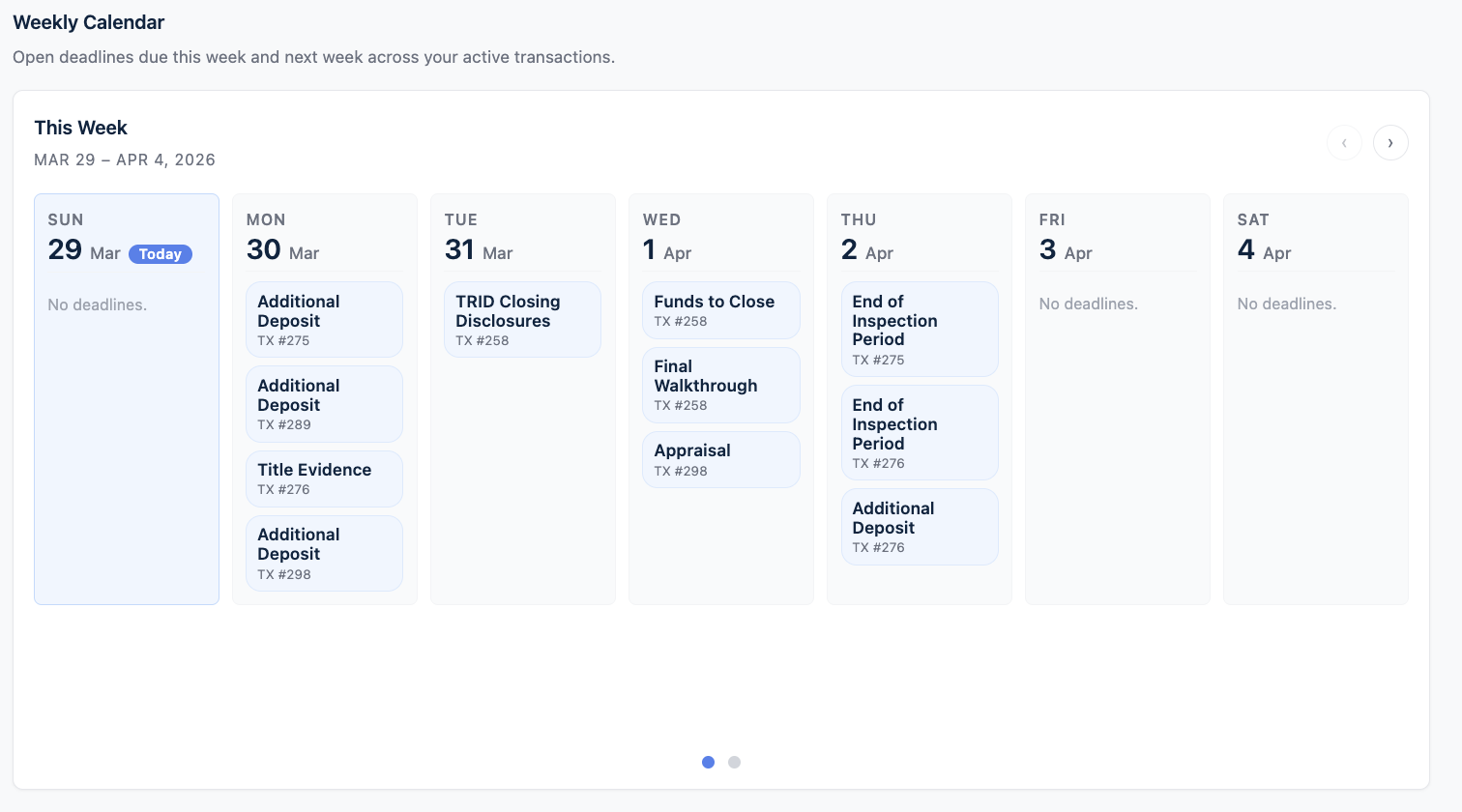
High-risk business-day windows in 2026 for Florida real estate professionals
If you only remember one operational habit, remember this: plan around the high-risk clusters, not just the holiday dates.
Why Florida teams should care in 2026

Where business-day counting changes transaction timing

The practical danger is not a holiday in isolation. It is the way weekends, observed closures, and vendor schedules stack together inside a transaction timeline.

1
Lender and title queues
One missing business day can turn a manageable file into a rush file if the decision or document cannot be processed until the next working day.
2
Inspection and appraisal scheduling
Florida markets move fast. Holiday weeks make already-busy vendor schedules tighter.
3
HOA, condo, and compliance timing
Association offices and related document workflows often slow down when the rest of the week is already shortened.

That is why a business-day calendar matters operationally. It helps you see not just the deadline, but the working time available before the deadline arrives.

Sample scenarios

How a deadline can shift in real life

1
Inspection period over Juneteenth
A 10-business-day window that starts Monday, June 15 loses Friday, June 19 to the holiday. The workable window stretches later than many people first assume.
2
Financing window over Thanksgiving
Even if only Thanksgiving itself is a federal holiday, many offices run at reduced capacity the following Friday. The practical effect can be bigger than the legal counting rule alone.
3
Year-end closing pressure
Closing on December 23 may look safe until you factor in reduced staffing, holiday wire timing, and the possibility that recording or post-closing tasks roll into the next week.

This guide focuses less on the holiday list itself and more on how those dates change the way a Florida team should plan the file. The point is operational clarity, not just reference information.

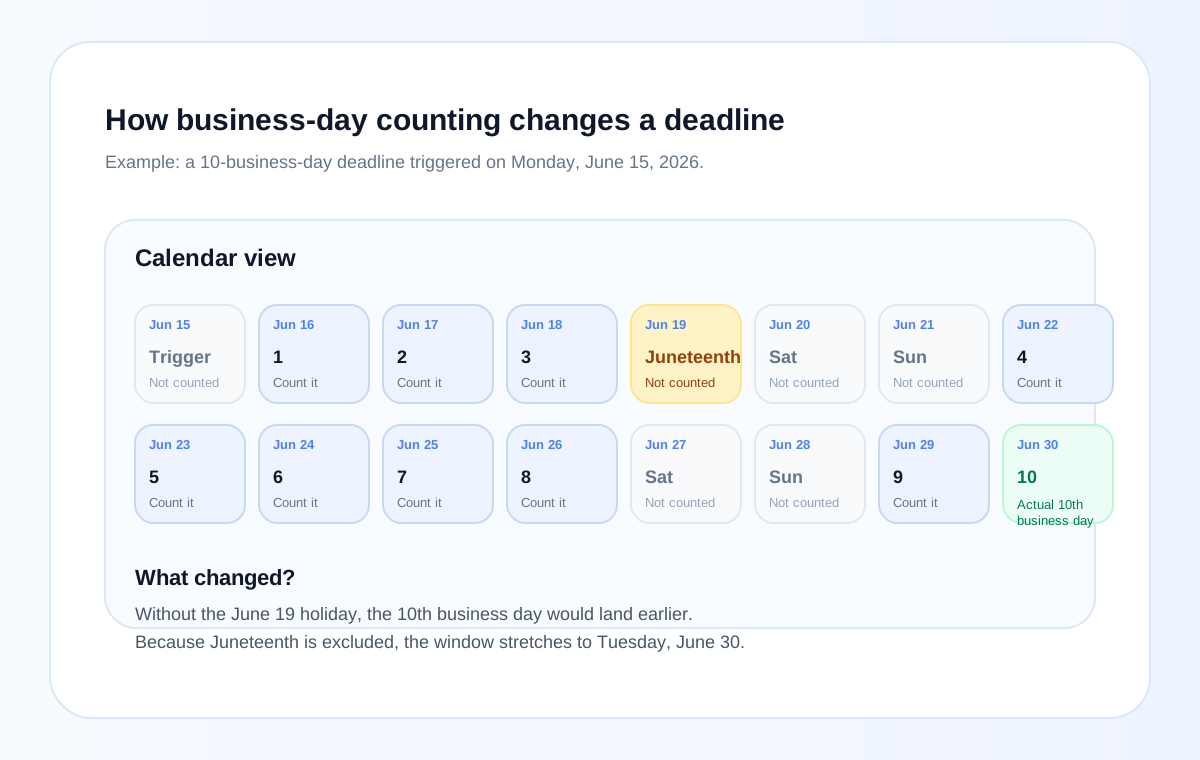
Calendar and timeline views inside Deadline Monitor for planning deadline-driven transaction work
Software is not useful because it looks organized. It is useful because it reduces the chance that one compressed week quietly creates multiple deadline problems.
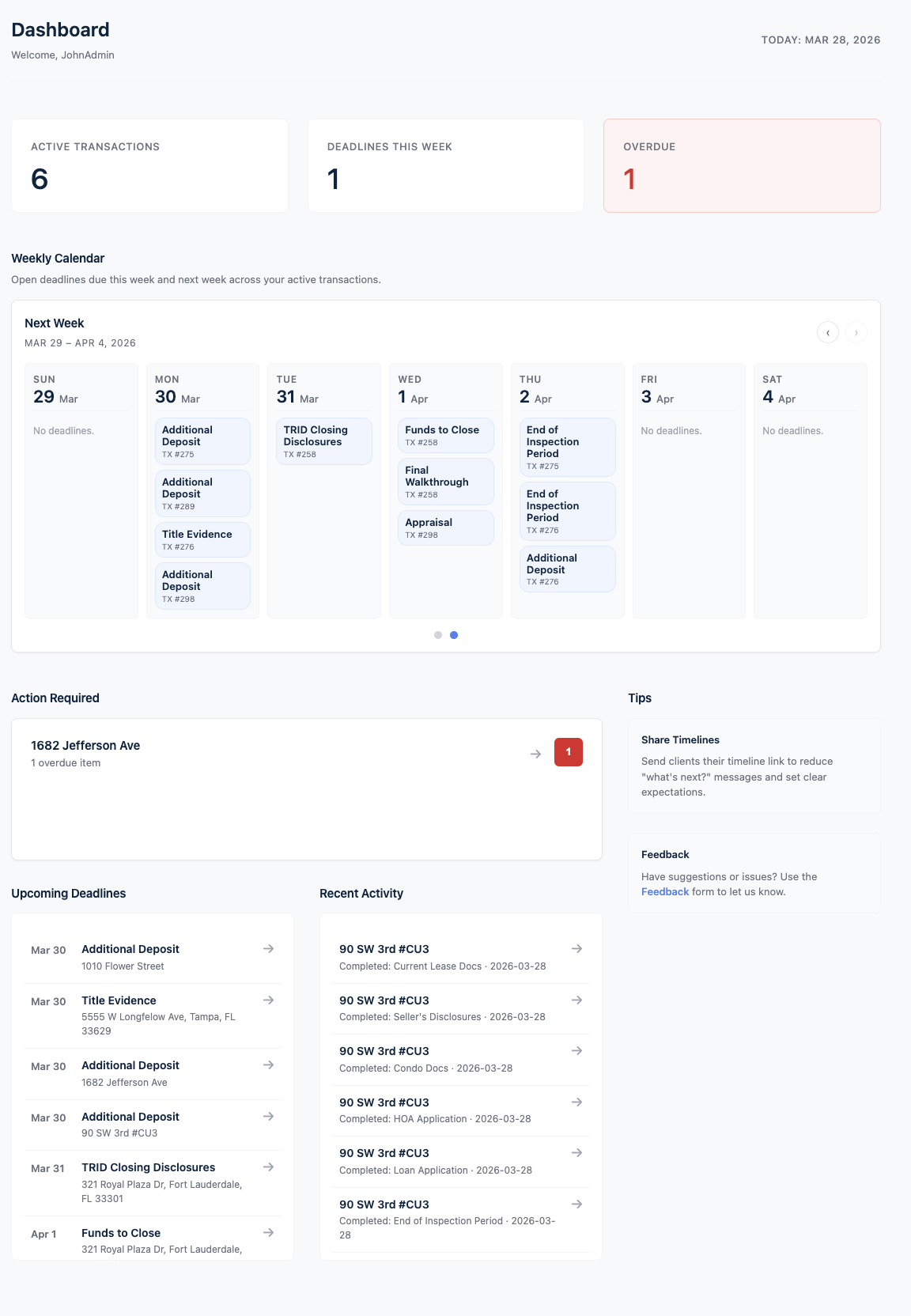
Dashboard overview inside Deadline Monitor showing multiple active transactions
This is where agents and coordinators feel the difference between one transaction and many. The workflow has to scale without depending on memory.
Agent + TC workflow

How Florida professionals can reduce risk

At contract creation
Flag any deadline that relies on business-day counting or on outside-party response time.
Before a holiday week begins
Confirm the actual availability of lender, title, inspection, recording, and association contacts.
During high-volume periods
Use one system for reminders instead of rebuilding logic separately in spreadsheets, calendars, and inboxes.

That is where Deadline Monitor fits naturally. It does not replace legal judgment or broker guidance. It replaces scattered deadline tracking with one visible system for reminders, timeline control, and client-facing progress.

FAQ

Common questions about the 2026 business-day calendar for Florida real estate deadlines

What does a business-day calendar mean in real estate?

It is a planning view that highlights which days are likely to count as working days and which days can interrupt lender, title, recording, and coordination activity. The contract still controls the actual counting rule.

Why should Florida real estate professionals care about the 2026 calendar specifically?

Because several 2026 holidays create compressed windows during active transaction periods, especially around Juneteenth, the observed Independence Day closure, Thanksgiving, and Christmas.

What is the difference between a business-day deadline and a calendar-day deadline?

Calendar-day deadlines count every day. Business-day deadlines usually exclude weekends and observed holidays, though the exact contract language should always control.

What is the highest-risk period in 2026?

Late June through early July is one of the highest-risk stretches because two Friday closures land within two weeks. Thanksgiving week and late December are also high-risk periods.

Can software reduce holiday-related deadline risk?

Yes. The biggest advantage is consistency. Software helps teams avoid recalculating dates and reminders manually across multiple files when the calendar gets crowded.

Is this page legal advice?

No. It is an operational guide designed to support cleaner planning, better reminders, and stronger workflow discipline.

Conclusion

A business-day calendar is useful. A working system is better.

If your team is serious about avoiding deadline surprises in 2026, the goal is not to memorize more dates. The goal is to use one workflow that already accounts for them. Deadline Monitor turns contract dates into a visible timeline, sends reminders before due dates, and keeps the client experience cleaner along the way.